
Total storage capacity in stainless steel tanks.
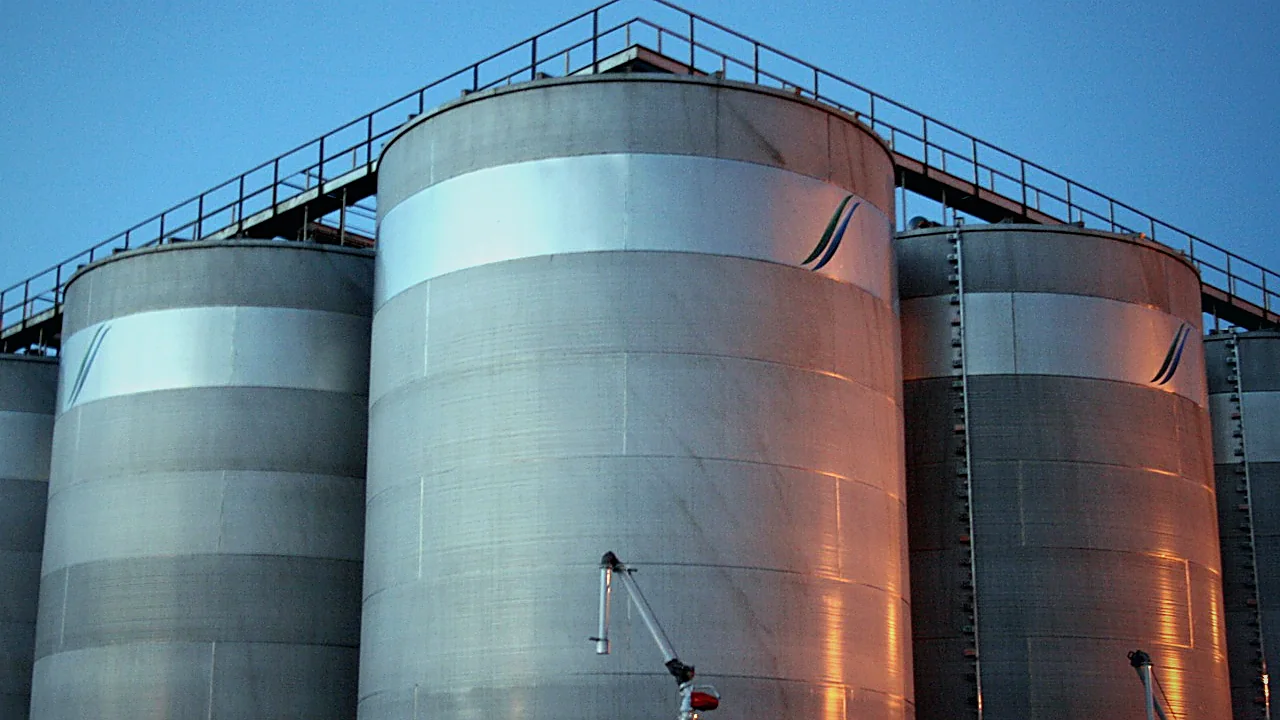
Terminal infrastructure
Stainless steel systems for controlled bulk liquid storage.
At Dock 24, AISI 304 tanks, dedicated stainless steel lines and tank-specific heating support product-specific movements from vessel interface to storage and release.
Terminal configuration
A clear technical profile for storage planning.
The installed configuration combines tank capacity, marine access and product-dedicated transfer systems within the Port of Civitavecchia.
AISI 304 tanks: 9 × 750 t and 10 × 800 t.
Stainless steel lines allocated to product-specific movements.
Direct port access with a 14 m draught.

Technical detailStainless steel transfer infrastructure
Product-specific handling
Tanks, lines and heating are assessed as one operating system.
Tank allocation is not considered in isolation. Product characteristics, transfer route and thermal requirements are reviewed together before an operating configuration is proposed.
AISI 304 tank bank
Nineteen stainless steel tanks provide two parcel configurations, supporting storage planning across different quantities and campaign profiles.
Dedicated transfer paths
Six stainless steel lines and product-dedicated loading and unloading support controlled movement between the marine interface and the selected tank.
Tank-specific heating
Each tank has dedicated heating, allowing temperature requirements to form part of the technical feasibility review.
Inside the system
Three infrastructure layers support each movement.
Pumping, tank heating and electronic weight control are separate technical functions, but they are reviewed together when defining the operating configuration for a product.

Transfer infrastructure
Pumping station
The stainless steel pumping station organizes transfer paths through its pump and valve network. Product routing is defined within the operating plan for each movement.

Temperature management
Tank heating control
Dedicated valves form part of the heating arrangement used to manage the temperature requirements of each tank.

Tank-level measurement
Electronic weight control
Each tank is equipped with electronic weight control, supporting quantity monitoring at the point of storage.
Control, data and security
Operational visibility extends beyond the tank bank.
Measurement, data management and site security systems support controlled terminal operations and structured information management.
GALILEO data management
IBM AS400 GALILEO supports terminal data management.
Video surveillance
Internal and remote video surveillance supports site oversight.
Perimeter alarm
The perimeter alarm is interfaced with the port authority.
Infrastructure development
Additional capacity is already in progress.
The terminal development programme is expanding storage capability while preparing a future rail interface. These projects are presented as developments in progress, not as currently available capacity or connectivity.
Four additional storage tanks, each with a nominal capacity of 1,500 tons.
A future rail connection forms part of the terminal development plan.

Photographic update: . The image shows the construction area for four additional tanks, each with a nominal capacity of 1,500 tons.

Historical cartographyA long-standing Mediterranean gateway
The port through the centuries
Civitavecchia has connected Rome and the Mediterranean since the age of Trajan.
Built under Emperor Trajan to a design by Apollodorus of Damascus, the harbour established Civitavecchia as a maritime gateway for Rome. After late-antique and medieval transformations, it regained strategic and commercial importance under the Papal States through restoration and new fortifications.
Roman foundation
In the Trajanic age, the port and the city of Centumcellae developed as maritime infrastructure serving Rome.
Papal renewal
Renewed trade and alum exports supported restoration of the harbour. In 1508 Pope Julius II commissioned the fortress later known as Forte Michelangelo, completed in 1537.
Mediterranean continuity
Across the centuries the harbour has remained a setting for Mediterranean exchange. Dock 24 places today’s terminal operations within that enduring port context.
Historical references: Port of Civitavecchia and Forte Michelangelo, Municipality of Civitavecchia.
Infrastructure fit
Available capacity is only one part of the assessment.
Each enquiry is reviewed against the physical and operational characteristics required for safe, compatible handling.
Product and documentation
Product family, classification and SDS where applicable establish the basis of the review.
Quantity and duration
Parcel size, storage period and release pattern are matched to tank configuration and availability.
Temperature profile
Heating requirements, viscosity and discharge conditions are checked against the available systems.
Transfer compatibility
Line allocation, loading and unloading sequence, segregation and operating constraints determine final feasibility.
Qualified terminal assessment
Match your product and movement to the appropriate terminal configuration.
Share product, quantity, timing, temperature and logistics details so the terminal can assess the appropriate infrastructure configuration.